Are solar systems, home chargers, electric cars, and battery storage systems familiar terms to you? Then you should be able to tap into the energy savings from self-generation and energy efficiency! A new, multifunctional switching device significantly simplifies in-house DC management.

Industrial direct current (DC) grids offer a way to stay one step ahead of ever-rising energy costs. Electricity generated by the company’s own solar system and recovered from the motion of its own machinery is stored directly in the company’s own battery storage systems and used in its own production. The widespread roadblock here is alternating current (AC). Because if a company’s internal power grids operate only on AC, conversion is always necessary. And every conversion from direct current (DC) to alternating current (AC) and back again costs energy—and thus reduces efficiency.

Phoenix Contact sees itself as a pioneer in DC technology. And it leads the way with innovative solutions. This example is called the All Electric Society Factory, a new production facility on the Blomberg campus. The company’s in-house machine building division is housed in this 18,500-square-meter facility. One of the innovative solutions is a printing press developed there, which prints information and the logo onto Phoenix Contact terminal blocks. It operates directly on direct current from the DC power grid installed in the building.
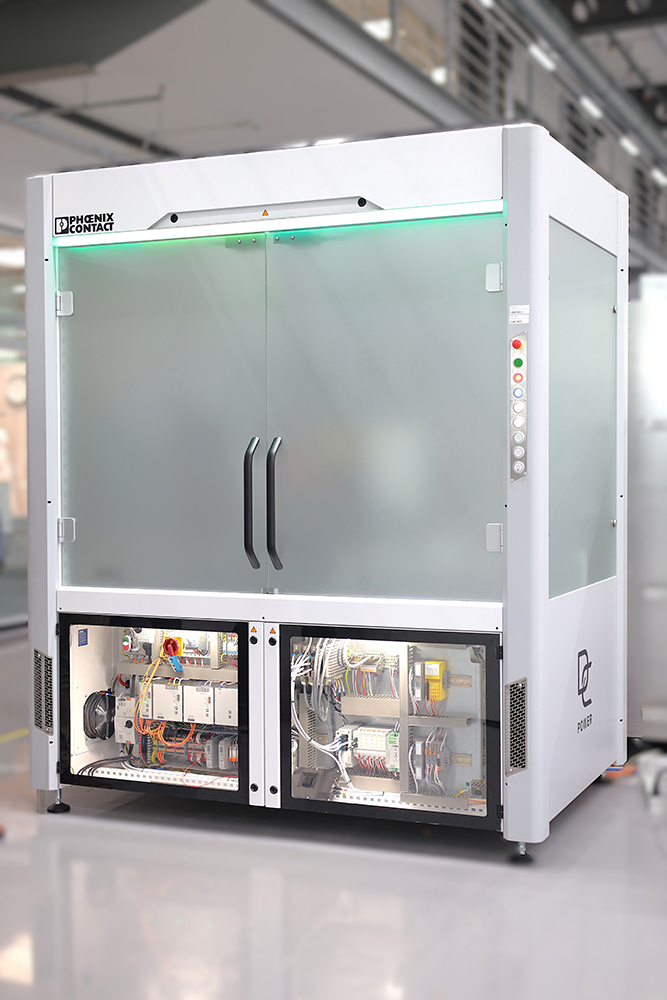
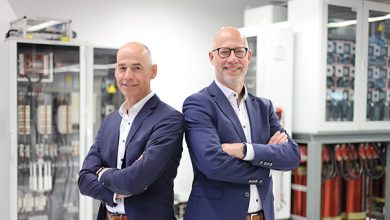
To enable it to do so, it must be taught how to manage its energy consumption. Along with a number of other new developments, this task is handled by the innovative circuit breaker ELR HDC. Sascha Garzke is the product manager for this multipurpose device and specializes in DC applications. He is supported by Tobias Lüke, also a proven expert when it comes to DC. “The printer itself is actually a standard device,” says Lüke, referring to the man-sized unit housing the ELR HDC. “We took care of its power supply and made it capable of being directly powered by direct current from our in-house DC microgrid. The direct current is used to power the drives, the sensors, and the control technology for the printing process.”
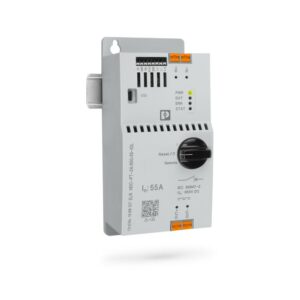
The Contracton ELR HDC was first unveiled to the public in 2024. “Back then, the industry’s focus on direct current wasn’t quite as pronounced yet, so we were almost a little too early,” says Sascha Garzke, describing the development. It took three years for the initial idea to become a finished product. The ELR HDC was so innovative that the device could not be classified under any of the existing standards. “We were the first in the world to introduce a DC switch of this kind in this performance class and with these capabilities.”
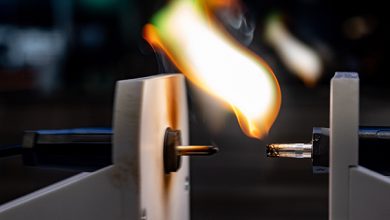
In the DC power supply of industrial DC microgrids, switching operations pose a particular challenge. While in alternating current (AC) systems an electric arc—which can also occur here—automatically extinguishes within ten milliseconds at the latest when the current crosses zero, in direct current (DC) systems, particularly during shutdown, a sustained electric arc develops whose destructive energy must be controlled. To make matters worse, short-circuit currents in DC microgrids rise extremely rapidly due to the network architecture. And this is exactly where the Contactron ELR HDC DC circuit breaker comes into play: modern semiconductor technology that, in combination with DC relays, switches without arcing. This ensures that the delicate switching process in direct current is performed safely and significantly extends the service life of the components involved.
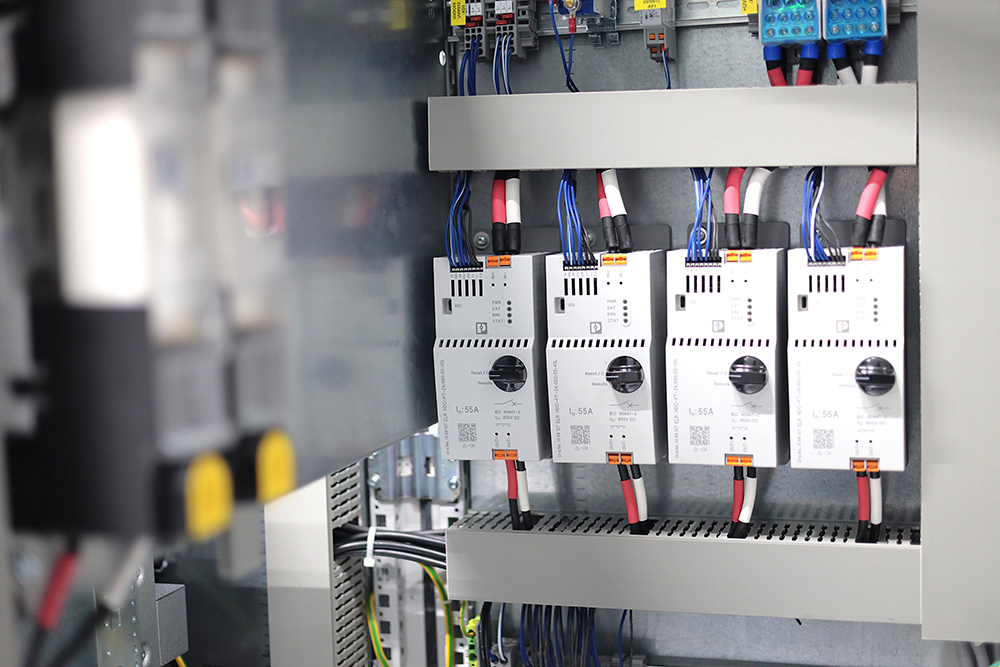
Sascha Garzke explains: “In addition to simply switching currents of up to 55 A at voltages of up to 810 V, the circuit breaker also monitors the most important parameters. If the operating current exceeds the set maximum value, the ELR HDC trips with a time delay, ranging up to a very fast short-circuit trip. Thanks to the semiconductors used, this occurs in microseconds, with three different tripping procedures depending on the load size. And if an under- or overvoltage occurs at the input, the device also trips. In addition, the circuit breaker charges capacitors at the output to the input voltage, thereby preventing current spikes during turn-on.”

You can tell that this industrial engineer and energy technician is enthusiastic about “his” circuit breaker. Before Garzke joined Phoenix Contact five years ago, he worked for many years in the field of custom machine manufacturing. So, you might say he has a professional penchant for specialized solutions: “The Contactron ELR HDC features a digital input/output as well as a communication interface for integration into network environments. Users can conveniently adapt the device parameters to their requirements via the network or using Phoenix Contact’s clipx ENGINEER parameterization software. To do this, they connect the circuit breaker to their laptop via a USB-C interface and simply configure the device parameters according to their application. Users can also collect operating data via the communication interface.”
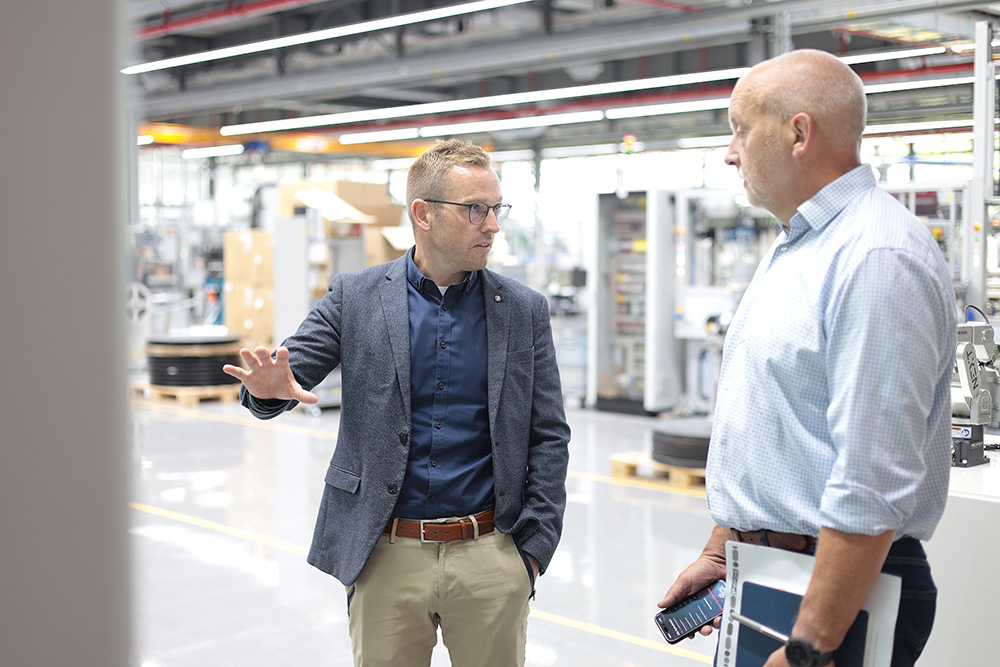
DC expert Tobias Lüke outlines the context in which the ELC HDR is intended for use: “Originally, the impetus for its development came from the automotive industry, where our combined unit was also extensively tested. But now we’re receiving inquiries from sectors such as building services engineering, factory automation, and charging infrastructure, among others. Data centers are also a major focus due to their requirement for extremely high availability, which must be guaranteed.” Garzke adds: “We’re active wherever direct current is to be used. Power-to-X, for example, is a major field, because the splitting of water into hydrogen and oxygen can only be achieved with direct current. And many customers are now approaching us with applications that present entirely new requirements, such as much higher power levels. That’s where we’re already reaching the limits of the Low Voltage Directive—that’s where medium voltage comes into play.”

The two experts are in complete agreement: “Direct current dominates virtually all applications in everyday life – whether commercial or residential. This fact, combined with the much simpler use of renewable energy sources and higher efficiency, makes DC technology a key driver for the energy supply of the future.”
Efficiency meets sustainable safety. Or as Sascha Garzke sums it up with a smile: “Protect, monitor, control, and communicate in DC networks. All with a single device. That’s how it should be!”
Phoenix Contact Contracton ELR HDC
Phoenix Contact Arc Zero – die Lichtbogenbändiger
Phoenix Contact Gleichstromnetze